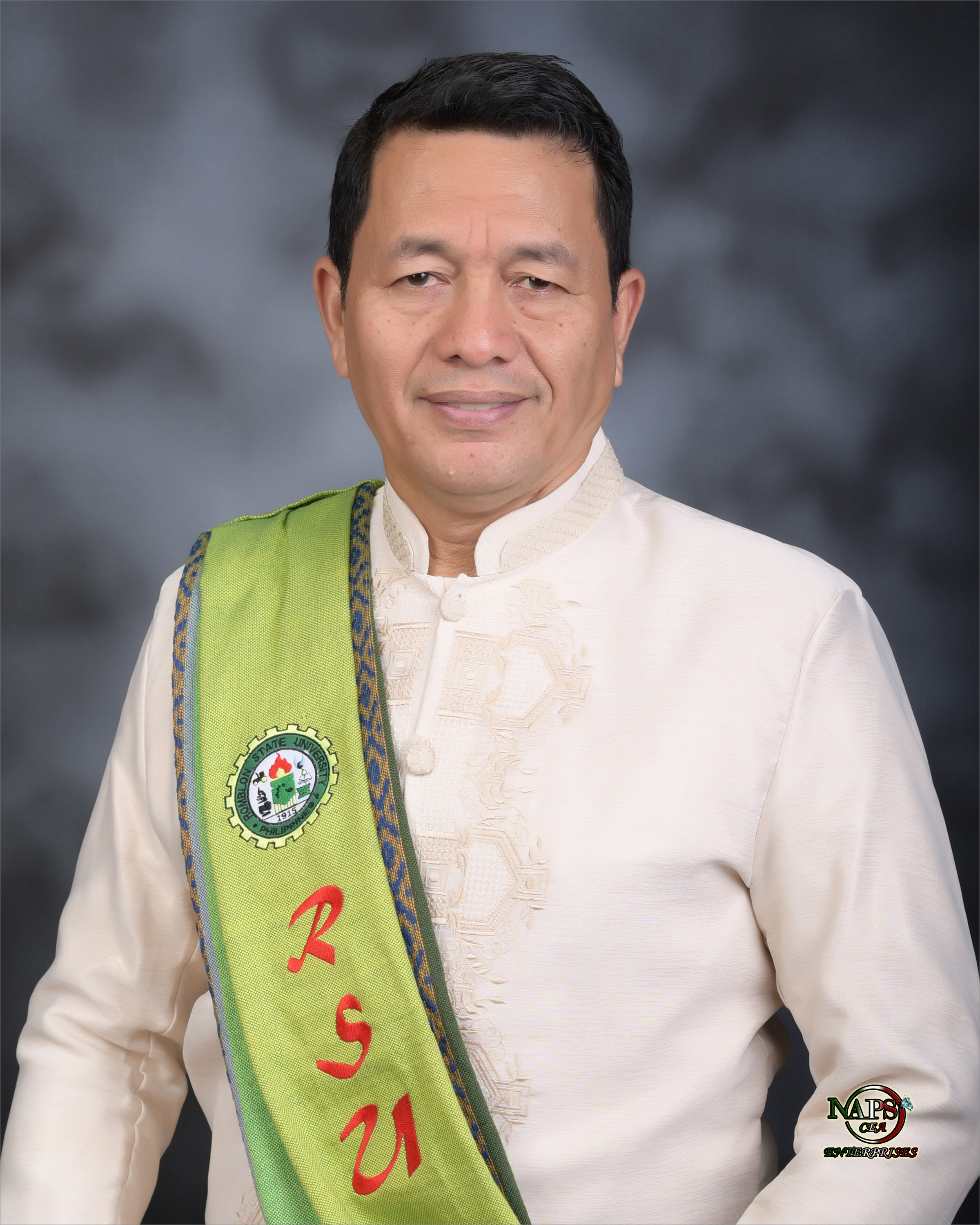
College Dean
Engr. Orley G. Fadriquel
"Advancing society through engineering excellence."
Our MissionTo produce innovative and ethical engineers.

College Dean
To produce innovative and ethical engineers.
Explore the diverse educational pathways offered by the College of Engineering and Technology designed for future leaders.
The Bachelor of Science in Agricultural and Biosystems Engineering program is designed to produce graduates who possess knowledge, skills, and attitudes in the application of engineering science and designs to the processes and systems involved in the sustainable production, post-production, and processing of safe food, feed, fiber, timber, and other agricultural and biological materials; the efficient utilization of, conservation, and management of natural and renewable resources; and development of climate change mitigation measures to enhance human health in harmony with the environment. Agricultural and Biosystems (AB) consist of crops, poultry, livestock, fisheries and aquaculture resources, forestry and other plants, new and renewable energy, wastes, natural resources, and climate.
Civil Engineering is a profession that applies the basic principles of science in conjunction with mathematical and computational tools to solve problems associated with developing and sustaining civilized life on our planet. Civil Engineering works are generally one-of-a-kind projects; they are often grand in scale, and they usually require cooperation among professionals of many different disciplines. The completion of a civil engineering project involves the solution of technical problems in which information from numerous sources and myriad non-technical factors play a significant role.
Grounded in CHED Memorandum Order No. 88, Series of 2017, the BSEE curriculum integrates both theoretical and practical learning experiences. It prepares graduates to address real-world challenges in areas such as power generation, transmission, and distribution; electrical systems design; automation and control; and renewable energy.
The Bachelor of Science in Mechanical Engineering (BSME) program is a four-year undergraduate curriculum designed to equip students with foundational knowledge and practical skills in mechanical systems and processes. Comprising 188 units per academic year, the program focuses on core areas such as thermodynamics, machine design, materials science, manufacturing technologies, power plant design, renewable energy, and industrial plant engineering. It emphasizes innovative problem-solving, computational techniques, and hands-on laboratory work, preparing graduates to excel in energy, manufacturing, and automation industries. The curriculum integrates theoretical instruction with applied learning to foster the development of professional competencies aligned with global engineering standards. The program has a Certificate of Program Compliance (COPC) No. 304, series of 2022 granted by the Commission on Higher Education (CHED). This means that the program complies with the minimum requirements of CHED.